.svg)

.svg)
-cropped%20(1).svg)
.svg)
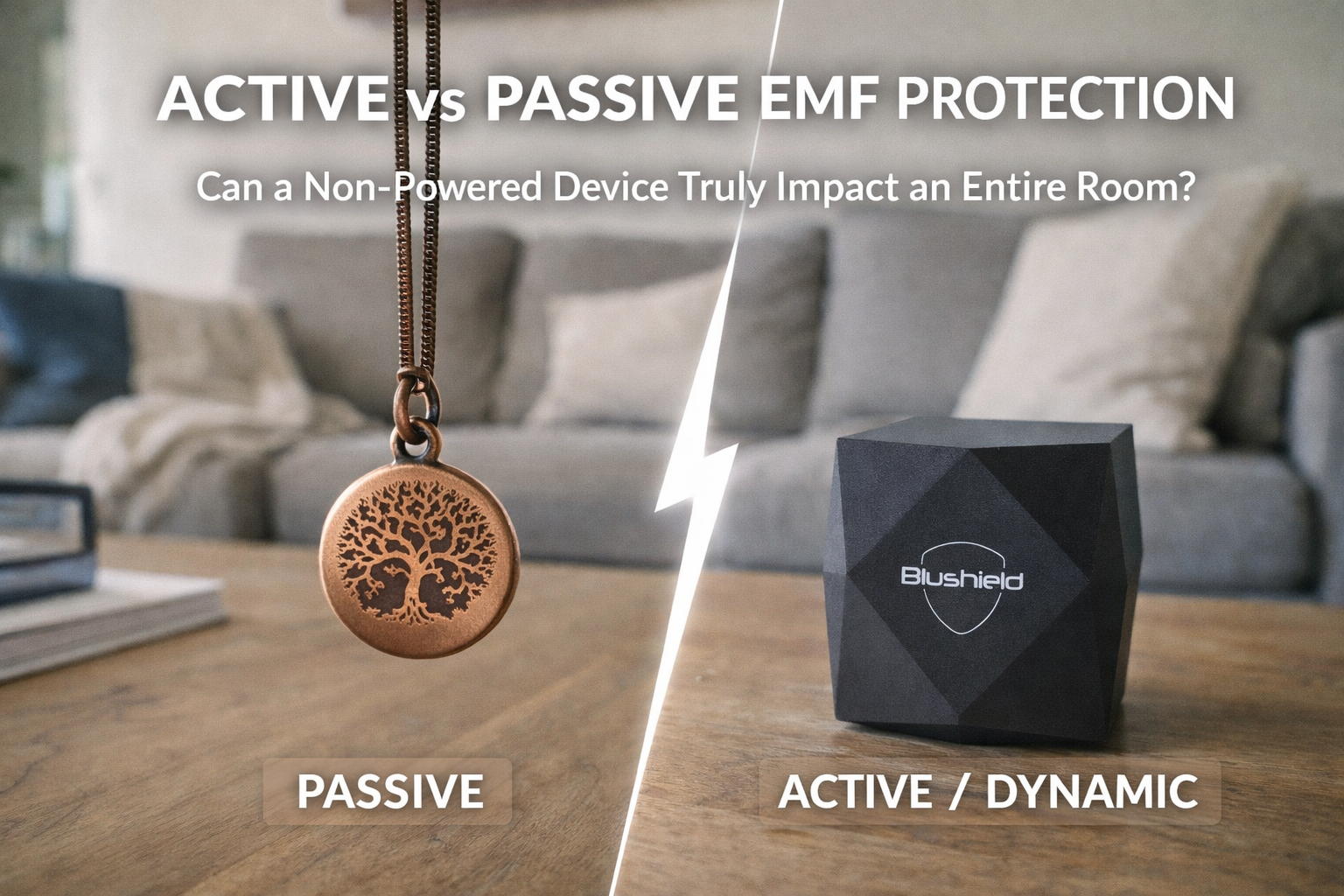
Active vs. Passive EMF Protection: Can a Non-Powered Device Truly Impact an Entire Room?
May 11, 2026
.png)

.webp)

The Science of Stability: Why Powered EMF Protection Outperforms Passive Devices
In our increasingly hyper-connected world, the conversation around Electromagnetic Fields (EMF) has shifted from "if" we should protect ourselves to "how" we should do it. As we surround ourselves with 5G towers, Wi-Fi routers, and smart appliances, the market has been flooded with solutions ranging from stickers and crystals to sophisticated electronic resonators.
However, not all protection is created equal. To understand why some methods fail where others succeed, we have to look at the physics of signal dominance and the biological need for a coherent reference.
The Passive Problem: The Limitation of "No Power"
Passive EMF protection products such as shungite, specialized stickers, or unpowered pendants operate on the principle of attenuation or local field alteration. While these materials may have unique molecular structures that interact with frequencies, they face a fundamental "physics wall": they lack an internal energy source.
Without power, a device is purely reactive. It cannot create a signal; it can only respond to the signals already present in the room. This leads to three critical failures in a modern environment:
01. Lack of Signal Dominance
For the body to prioritize a "healing" or "balancing" frequency over the chaotic noise of a Wi-Fi router, that frequency must be dominant. Passive devices are essentially "whispering" in a room where the EMF environment is "shouting." Because they cannot project a field, their influence is limited to the near field usually just a few millimeters or inches from the object.
02. The Trap of Ambient Fluctuations
Passive devices are at the mercy of their environment. If the ambient EMF levels spike (like when you take a call or download a large file), the passive device has no way to scale its interaction. It cannot maintain a structured reference signal because it is constantly being "pushed around" by the very frequencies it is meant to harmonize.
03. No Timing or Pulse Control
Biological systems are highly sensitive to rhythm and timing. Active EMF protection often uses specific pulse-width modulation to mimic natural Earth frequencies (like the Schumann Resonance). Passive devices have no "heartbeat"; they lack the circuitry required for timing control, meaning they cannot provide the rhythmic consistency the body needs to stay grounded.
The Active Advantage: Establishing a Coherent Reference
Powered, dynamic signaling systems represent a different paradigm of protection. Instead of trying to block or absorb radiation which is nearly impossible in a modern home these devices focus on Active Resonance.
Building a "Safety Bubble"
A powered device uses a dedicated power source to emit a consistent, coherent, and structured electromagnetic field. Because this signal is generated internally, it is not dependent on the noise of the room. It creates a stable "reference point" that remains constant regardless of how many devices are active in the house.
Conclusion: Why Power Matters
In the quest for wellness in a high-tech world, we must choose tools that match the scale of the challenge. Passive materials certainly have their place in history and personal practice, but they lack the "active voice" required to compete with the high-output infrastructure of modern telecommunications.
If the goal is to create a true sanctuary a space where biology can rest independent of the changing electromagnetic tide a powered, dynamic system is not just an upgrade; it is a necessity. By establishing a dominant, coherent reference signal, we provide our bodies with the stability they need to thrive in the digital noise.

.png)
This post copyright ©2020–2026 Blushield USA. All rights reserved.
Unauthorized use and/or duplication of this material without express and written permission is strictly prohibited.
Explore more Articles
Why I ultimately chose active and dynamic field signalingMy name is Brandon Amalani and I have been running Blushield.com for nearly ten years.People regularly ask me about passive EMF protection devices and whether they are reliable or effective at protecting biology from man made electromagnetic exposure. That question comes up more now than ever, especially as passive devices have become extremely popular in recent years. I want to be very clear from the beginning that this article is not an attack on anyone or any company. It is an honest attempt to explain what I have learned about physics, biology, and signal behavior after a decade of working directly in this space.I originally got involved with Blushield after personally exploring many of the options available at the time. Most of what existed were passive EMF devices such as stickers, pendants, resonator chips, cards, and other non powered products. There were also shielding materials, grounding strategies, and constant single frequency generators. I tested all of these myself and spent a lot of time learning where each approach worked and where it clearly did not.That was about ten years ago. Since then I have worked closely with inventors and researchers in the electro therapy space and continued my education across multiple disciplines including cold plasma technology, photobiomodulation, PEMF system design, cellular biology, nutrition, and herbalism. Having this cross-disciplinary perspective has been critical in helping me understand how the human body functions as an electromagnetic system and how it interfaces with both natural and man made fields.Over the years I have noticed a shift in how passive EMF devices are discussed and marketed. Many educators and companies have moved away from older language like depolarizing EMF or harmonizing waves, and are beginning to use more nuanced terminology around coherence and biological signaling. That shift is a step in the right direction. However, based on what people share with me and what I continue to observe, there is still a great deal of confusion around the actual physics and biology involved.There are really three categories worth discussing. The first category is passive EMF devices. These devices have no power source. They claim to harvest ambient electromagnetic radiation and reorganize or modify those fields in a way that reduces biological stress. They often rely on geometry, fractal patterns, holograms, microchips embedded in pendants, or specific material combinations. The second category is active EMF signaling devices. These devices are powered systems that intentionally emit weak structured signals. They do not claim to overpower ambient EMF. Instead they claim to bias biological systems toward more coherent endogenous signaling and improved physiological resilience. The third category is what I would call active and dynamic signaling systems. Blushield falls into this category. It is active because it generates a field using an internal power source. It is dynamic because the signaling changes over time in a coherent way, more closely resembling the constantly shifting electromagnetic environment found in nature.To be clear, many of the concepts used to justify passive devices are not crazy or unscientific. Electromagnetic fields do have polarization. Geometry can influence how fields interact with materials. Fractal antennas exist in real engineering applications. Metals can couple to radiofrequency energy and act as grounds. Passive objects can scatter or redirect fields locally in the near field. All of that is true. This is why claims like an intentionally designed resonator can reorganize harmful EMFs and make them less biologically stressful sound persuasive on the surface.The issue is not the concepts themselves. The issue is scale, control, and guarantees.A passive resonator may produce higher local field intensity at specific frequencies by storing energy temporarily, much like a tuned antenna. However, this is concentration, not amplification in the engineering sense. Without an internal power source and maintained oscillation, a passive device cannot generate a dominant reference signal or enforce coherent structure across a room-scale environment.Without power, a device cannot control timing, phase, modulation, or coherence. It is entirely dependent on whatever ambient electromagnetic environment happens to be present at that moment, which is constantly changing. Geometry without power has no authority over signal behavior. Passive devices can respond to fields, but they cannot impose order on them.Over the years I have had many conversations with inventors working in active electromagnetic systems, including plasma based technologies. One important distinction that comes up repeatedly is that plasma can behave like a fractal antenna because it is an active medium with mobile charge carriers and energy input. That is fundamentally different from static geometry, etched holograms, or water/copper coil circuits which do not maintain oscillation, timing, or coherence on their own.Fractal antennas are real in engineering. However, they require specific parameters such as tuning to defined frequency ranges, feed points, impedance control, and known boundary conditions. A static hologram etched onto a pendant or card does not dynamically store electromagnetic information, adapt to changing environments, or enforce coherent signaling. It is a constraint, not a reference. Plasma systems can act like fractal antennas because they are active. They contain mobile charge carriers, dynamic oscillation, and energy input. That is a fundamentally different physical system than a static etched interference pattern. Calling both of these fractal antennas is a category error.One question that always stood out to me was how passive devices claim to cover large areas with no internal power source. Passive devices may slightly alter local coupling when worn on the body. That is plausible. What is not clear is how they could control room-scale fields or guarantee uniform effects across space. If a device truly created a dominant room-scale field, orientation, placement, and surrounding electromagnetic conditions would not matter. In reality, indoor EMF environments are dominated by near field sources such as laptops, phones, routers, and wiring. These signals reflect off walls and floors, creating standing waves and nulls. The result is a highly patchy and inconsistent field landscape. A small passive device only interacts with the local field where it is placed. It cannot average or reorganize an entire room. Its behavior will change depending on proximity to sources, wiring, and the body itself. That tells us the environment is in control, not the device.Passive devices have no internal timing reference, no phase authority, and no feedback mechanism. A passive microchip or circuit does not qualify as an internal reference because it does not actively maintain timing, state, or phase. Geometry and materials can constrain how a device responds to incoming signals, but they cannot enforce or stabilize a desired signal state. A reference requires actively maintained timing or coherence. Passive systems do not have that capability.Depolarization is another concept that has been widely misunderstood. Polarization refers to the orientation of the electric field. Coherence refers to phase stability and predictability over time. These are not the same thing. Modern radiofrequency environments are already spectrally complex, weakly polarized, and highly incoherent. Further depolarizing these fields simply adds randomness. It does not restore order. You cannot fix incoherence by adding more noise.In recent years many companies have used portable EEG devices to demonstrate before and after changes in brain activity. EEG can certainly reflect changes in mental state such as relaxation, attention, novelty, or expectation. It is extremely sensitive to posture, breathing, emotional framing, and context. What EEG cannot demonstrate is environmental EMF control, room-scale field effects, or mechanism of action. EEG does not measure cellular health, gene expression, calcium channel behavior, oxidative stress, or electromagnetic exposure levels. It tells you that a brain state changed, not why it changed. A device worn on the body could plausibly induce a local coupling effect. That does not mean the surrounding environment was altered. Small numerical changes can also appear dramatic depending on visualization choices and color scaling when creating before and after images.After evaluating many testing approaches, we chose to pursue the most rigorous path available to us. Rather than relying on internal or externally sourced white papers or theoretical models, we conducted an independent review board certified clinical trial in the United States. The results were published in a peer reviewed medical journal. We demonstrated significant changes in VGCC gene expression along with other physiological markers. This type of research is expensive and time consuming, but it aligns with the actual biological mechanisms being discussed.Biological systems are oscillatory, nonlinear, phase sensitive, timing dependent, and reference driven. This is why natural light cycles, geomagnetic fields, and environmental rhythms are so important to health. Biology does not simply respond to less stimulation. It responds to better organized information. The real question is not whether we can remove all EMF. It is whether we can provide a stable coherent reference that biology can lock onto.Active and dynamic signaling systems can do this. Passive systems cannot. Powered systems introduce a reference signal with internal timing and structure. That signal behaves consistently across environments. It improves signal to noise at the organism level. Passive systems have no phase authority, no internal timing, and no ability to resist environmental variability. They react to chaos, scatter chaos, and depend on chaos for their function. That is the opposite of what biology needs.Even mainstream EMF literature points to mechanisms such as VGCC activation, calcium influx, oxidative stress, and redox imbalance. An active coherent field can plausibly bias ion channel behavior, reduce stochastic noise, and support mitochondrial coupling. A passive scatterer cannot target these mechanisms or maintain biological reference states. Passive devices attempt to reorganize biology by harvesting incoherent ambient radiation. Active devices introduce order.We have been recommending Blushield for years as ones primary source of protection. Recently we introduced another technology that we found to pair perfectly with Blushield as the ultimate EMF protection stack.First, let’s look at the environment a bit closer.Modern EMF exposure isn’t just coming from wireless signals in the air. It also comes from the wiring inside our walls. Digital devices, switching power supplies, and LED drivers inject high-frequency transients and sharp voltage edges onto the 50/60 Hz electrical sine wave. That noise doesn’t just stay in the wires, it turns the wiring itself into a secondary source of electromagnetic variability.Blushield operates in the radiated domain by introducing a low-power, internally timed reference signal that remains stable even as the surrounding RF environment changes. It does not attempt to overpower external sources. Instead, it provides a consistent signal structure that biology can bias toward.SineTamer works at the electrical layer by reducing high-frequency transients and rapid voltage fluctuations on the building’s wiring. By lowering broadband electrical noise, it reduces the background variability that wiring can radiate into living spaces.Together, these two approaches address different layers of the same problem: one introduces structured reference signaling, the other reduces injected electrical noise. The result is not “shielding,” but a shift in signal organization and environmental stability.I genuinely want passive devices to be highly effective. I also want Nikola Tesla’s dream of a small portable device that produces clean energy from ambient energy to be real. But wanting something to be true does not make it physically possible yet. After ten years of experimentation, education, and direct testing, active and dynamic field signaling remains the most plausible approach I have seen for supporting biological resilience in modern electromagnetic environments.

Half a year after the MAHA Report by the United States government did a preliminary assessment of toxic exposure sources in modern life that hadn’t been adequately addressed, and only briefly mentioned wireless radiofrequency (RF) radiation as a potential threat to human health, the U.S. Department of Health and Human Services (HHS) recently announced the launch of a new government commissioned study on the potential health risks of cell phone radiation.
Under Secretary Robert F. Kennedy Jr., considerable changes have taken place in the HHS and the FDA during this past year, including big shifts in government dietary and vaccine recommendations. Recently, longstanding FDA webpages asserting that cell phone radiation poses no health risks have been quietly removed, in preparation for a more comprehensive and hopefully less biased assessment of the health risks of non-ionizing radiation sources like cell phones, cell towers, Bluetooth, Wifi and smart meters, which many of us are closely and constantly exposed to in our daily lives. The FDA landing page about cell phone radiation now contains several links that reroute back to the landing page itself, after the individual pages were taken down.
"The FDA removed webpages with old conclusions about cell phone radiation while HHS undertakes a study on electromagnetic radiation and health research to identify gaps in knowledge, including on new technologies, to ensure safety and efficacy," said HHS spokesman Andrew Nixon.
Other government agencies like the FCC and CDC, however, still state on their websites that there is no evidence of health harm from wireless radiation.
At this time, no details have been shared about the study’s authors or design, indicating that the study is still in its early stages. However, the study announcement is encouraging, and seems to be a move in the right direction, especially in combination with the removal of FDA statements claiming no harm from these common radiation exposure sources.
Shocking results from a previous large government study were swept under the rug
Back in 2018, the publication of a massive government study on rats and mice by the National Toxicology Program under the National Institutes of Health (NIH) reported “clear evidence” of cancer and DNA damage from cell phone radiation. These shocking and unexpected results seemed to be inevitably leading to the U.S. government clearly stating the health dangers and taking charge of protecting public health.
Unfortunately, as we have previously detailed in our article about the NTP study, the FDA suddenly reversed their position and asserted that the expensive, well designed, perfectly executed NTP study could not apply to humans. This was a bold statement to make for a study that was specifically designed to translate to humans under the best “gold standard” scientific practices, especially after a peer review panel of experts interpreted the results as demonstrating “clear evidence” of cancer and DNA damage.
The FDA had undertaken an internal review between 2008 and 2018, concluding around the same time as the NTP study, which claimed “no consistent or credible scientific evidence” of harm from cell phone radiation. Interestingly, as Dr. Devra Davis points out, that review was never signed, which is unusual for a major public health document.
Dr. Davis’ opinion is that the review went unsigned because “no one in the FDA was willing to put their name behind such a piece of junk.”
Skepticism of the government’s motives by EMF scientist dampens enthusiasm
Some scientists who have devoted a large part of their careers to studying the harms of wireless radiation are skeptical of the U.S. government’s decision to do another study.Dr. Joel Moskowitz turned down an invitation from a Kennedy aide to participate in a literature review on wireless radiation, questioning the administration’s motives and approach by pointing out that enough research has already been done, and that waiting for yet another study would just delay regulatory change. “They’re just doing this to kick the can down the road,” he said.
Scott McCollough, lead litigator for CHD’s EMR & Wireless cases, was disappointed by Moskowitz’ position, as Moskowitz’ organization ICBE-EMF has long advocated for expert scientific recommendations to protect public health from EMFs. McCollough states that the HHS study appears to align with these goals.
The way we see it, it’s important to continue to be hopeful and optimistic about all progress in the right direction, even when it seems slow and incremental. Even though a lot of us feel fatigued by this long battle towards increased awareness and safety measures, the truth is that nothing changes quickly on a large, societal scale, especially those elements of society that permeate our daily lives so intimately. The momentum that the current iteration of wireless infrastructure has in our world is still rolling, and it may take a lot of time and effort to truly change course.
If there was a major change or breakthrough resulting in widespread admission and acceptance of the science showing harm from wireless radiation, the likely result would not be the dismantling of cell towers and people throwing their cell phones in the trash. Much more likely is a slow transition towards more reliance on wired internet connections like fiber optic and copper, phasing out unnecessary use of wireless, and widely propagated messages cautioning users to increase distance and reduce overall exposure to RF radiation sources.
Since wireless communication is still vital in our world for mobile and emergency use, the impetus for telecoms to invent and utilize new methods of transmitting wireless signals that are not harmful to living organisms could become much greater… but only IF there was an ultimatum put out by legislature that restricted their freedom to use harmful technologies. If telecoms are allowed to continue to do anything they want… well, we can already see from their past actions that money is a greater motivator than the health of humanity.
Fortunately, not everyone is waiting for the final verdict from a government study to make changes at local levels. Last year under the MAHA (Make America Healthy Again) movement, 22 states began restricting cell phone use in schools, to improve the mental and physical health of children. Our children’s health can’t wait for studies to give us 100% clear answers, and it is most vital for their current and future development to be cautious and conservative with potentially harmful exposure sources, and make changes now instead of waiting for a definitive government green light.
Swedish study shows sharp increase in sleep disorders in children and teens since 2001
A new study just released this month (January 2026) in Sweden found an astonishing 17-fold (1700%) increase in sleep disorders in teens and children since 2001. The age group that endured the most extreme increase were children and teenagers aged 5 to 19. Even young children under age 5, and young adults aged 20-29, experienced a 500% increase in sleep disorders. The study authors theorize that the exponential increase in wireless radiation exposure between 2001 and 2024, as well as blue light exposure from screens (which can disrupt melatonin and affect sleep), is primarily responsible for this sharp and unprecedented increase in sleep disorder symptoms.
The study authors, Mona Nilsson and Lennart Hardell, analyzed national health statistics on sleep disorder diagnoses during this 23-year period. Hardell is the author of more than 350 papers, around 60 of which address the topic of radiofrequency radiation, and Nilsson is the co-founder and director of the Swedish Radiation Protection Foundation. They are both concerned that major government organizations and agencies, like the WHO, FCC, and European Union, are more focused on protecting the interests of the wireless industry than people’s health.
Mainstream media has frequently reported on the increasing incidence of sleep disturbances in children and teens, but has failed to consider a possible link to wireless radiation.
Another Swedish study from last year found an increase in memory issues, which goes hand-in-hand with sleep issues. Sleep quality, length and depth is vital for cognitive function, including memory.
Nilsson shared this list of nearly 60 studies on the link between radiofrequency radiation and issues with learning and memory.
HHS study a move in the right direction, but the time to protect children is now
The announcement of the U.S. government reopening research into the harms of wireless radiation is certainly good news, but we can’t afford to wait for their conclusion, especially when it affects our children and teens who are in the midst of critical windows of development. The influences that shape them now will become hardwired into their brain, nervous system and entire body, affecting their long term health and shaping their outlook for the rest of their life.
Children who get cell phones before age 12 are at higher risk of obesity, depression and poor sleep. Reducing access to cell phones at home and at school, and waiting until a child or teen is older before owning a personal cell phone, are some ways that we can support healthy development. Balancing out academic and recreational activities on screens with physical and outdoor activities, and prioritizing healthy sleep habits, can also go a long way.
Growing up in such a heavily technological world will pose unique challenges to this generation of children. Giving them a strong, healthy foundation will fortify them so that they can meet these challenges with clarity, discernment, healthy bodies and sound minds.
References:
- Children’s Health Defense: “HHS to Study Cellphone Health Risks, as FDA Scrubs Online Safety Claims” — https://childrenshealthdefense.org/defender/hhs-study-cellphone-health-risks-as-fda-scrubs-online-safety-claims/
- Reuters: “US health department to launch study on cellphone radiation” — https://www.reuters.com/legal/litigation/us-health-department-launch-study-cellphone-radiation-2026-01-15/
- Study: “Increasing Numbers of Persons with Sleeping Problems in Sweden” — https://www.mdpi.com/2079-9721/14/1/25
- Children’s Health Defense: “Kids’ Sleeping Problems Linked to Wireless Radiation, Screens” — https://childrenshealthdefense.org/defender/kids-sleeping-problems-linked-to-wireless-radiation-screens/
- Children’s Health Defense: “Kids Who Get Cellphones Before Age 12 at Higher Risk of Obesity, Depression, Poor Sleep”— https://childrenshealthdefense.org/defender/kids-cellphones-before-age-12-higher-risk-obesity-depression-poor-sleep-study/
- Blushield: “$30M National Toxicology Program Study Shows Cell Phone Radiation is Carcinogenic” — /blogs/30m-national-toxicology-program-study-shows-cell-phone-radiation-is-carcinogenic
- Blushield: “Downplayed Dangers: The Missing EMF Conversation in the MAHA Report” — /blogs/downplayed-dangers-the-missing-emf-conversation-in-the-maha-report

The electricity that we use to power the devices in our homes and buildings can be produced by a variety of sources. Natural gas, coal (burned to make steam), heat from nuclear energy, hydropower (moving water) and wind (moving air) can all create motion to spin a turbine, which is connected to a generator. The movement created by any of these sources spins the rotor in the generator, pushing electrons along a conductive coil, which interact with magnets to produce alternating current (AC) electromagnetic fields. This electricity travels to our homes via the power grid, and is a resource produced far away from our homes, which we depend on for most of our household routines.
Since the invention of solar power systems, which have become more economically viable over time, we now have the option to produce our own electricity directly from sunlight. This can decrease our dependency on the external power grid, and even reduce or eliminate our electricity bill. Most of us have plenty of sunlight where we live, at least during the warmer seasons, so in recent years as the components of solar power systems have become more affordable, this has become a viable option for home electricity.
The sun is a steady and reliable resource that most of us have direct access to. While the upfront cost of the components are a significant investment, a home solar power system can be economically advantageous in the long run.
How do solar power systems work to generate electricity?
With solar power systems, sunlight directly excites electrons held in crystallize materials like silicon, generating direct current (DC) electricity. This occurs on the surface of solar panels, also known as photovoltaic (PV) panels, which are placed in sunny areas like rooftops or open fields. The term photovoltaic refers to the generation of electrical voltage when photons of light come into contact with a material.
This DC electricity needs to be converted into AC to be usable by the electrical systems in homes and buildings – this is done with a device called an inverter. Inverters take the DC electricity and rapidly switch the direction back and forth, creating an “alternating” current – AC electricity. The inverter also ensures that the resulting AC matches the grid’s voltage, frequency and phase (in the United States it’s usually 120 volts at 60 hertz), to safely integrate the electricity into the grid. The end product from the harvest of solar energy generates electricity that’s identical to what’s produced by a generator powered by natural gas, coal, nuclear, hydro or wind.
Grid-tied versus off-grid solar systems – pros and cons
If a home solar power system is tied to the grid, this has several benefits and also some downsides. Batteries are by far the most expensive component of a solar power setup. With a grid tied solar system, you don’t need a battery to store the solar energy for use at night or during rainy or cloudy days – your solar power is fed directly into the larger electric grid, giving you an electricity “credit” that you can use later when it’s needed, automatically balancing out the fluctuating and unpredictable availability of sunlight. A grid tied solar system is far more convenient and flexible.
The main downside of grid tied solar power systems is that you’re still dependent on the electrical grid, even though you’re reducing your overall electricity cost by feeding your excess power into the larger grid. If the grid goes down, your power goes out, unless you have a generator as a backup. Another downside is that you’re almost certainly required to use a smart meter (unless your local area allows you to opt out), to accurately keep track of the electricity you’re sending to the grid and receiving back from it. Smart meters produce high levels of wireless radiofrequency (RF) radiation, and contaminate your home wiring with dirty electricity.
An off-grid solar system, on the other hand, is a closed system designed to produce all the electricity needs for a given location. This design requires much more forethought and careful planning, with enough solar panels to harvest sunlight energy for all household needs, a large enough battery bank to store power for use in times of the year with limited sunlight, and usually a backup generator for “worst case scenario” situations. It also necessitates more discipline and careful timing of electricity use for those living at that location. Another downside of an off-grid system is that since all power is produced at the location of use, you could be exposed to higher levels of EMFs from the storage batteries and the potentially larger quantity of total equipment used by the system. The benefits of a well designed off-grid solar system are energy independence from the external power grid, and not needing to use a smart meter.
Solar power system EMF exposure concerns & mitigation strategies
Both types of solar power systems will expose you to some level of EMFs, but understanding the EMF hotspots generated by each type of system will give you clarity about how to reduce and mitigate these risks. Solar panels produce a small amount of low voltage direct current (DC) electricity, and since they are usually placed a good distance away from living areas, the panels themselves aren’t much of an EMF concern.
The wiring that runs from the panels to the inverter and/or battery emits EMFs, and if you’re designing a solar setup, one way to minimize EMF output from the wiring is to ensure that all the wires – positive, negative, neutral and ground – are run side-by-side, tightly paired or twisted together. If the wires are run separately, inches or feet apart from each other, a strong magnetic field will be created in the space between the wires. When they’re close together, the magnetic field is basically canceled, reducing ambient EMF readings.
Every solar power setup uses an inverter to switch the DC power from sunlight into the AC power used by the grid. Inverters create dirty electricity as a byproduct of this conversion, which enters your home wiring. However, it’s important to realize that even with a conventional power system (and no solar setup), you are still exposed to dirty electricity from devices within and outside of your home. Dirty electricity, a term that describes voltage transients, fluctuations or anomalies that “dirty up” an otherwise smooth and “clean” sine wave, is an issue for almost everyone who lives a modern, technology-rich life.
The difference in EMF exposure between grid tied and off-grid solar power systems is the presence or absence of a battery, and the presence or absence of a smart meter. Off-grid systems must use batteries, and grid tied systems almost always use smart meters.
Solar batteries produce static magnetic fields, with the highest readings right next to the battery, quickly dropping down to zero as you move further away. The extra exposure from a solar battery bank can be mitigated by having a dedicated power room or shed that’s separate from the house or living area where humans and pets spend time. Your inverter can be in this room, as well, preventing exposure to the EMFs directly around the inverter.
The EMFs from a smart meter cannot as easily be mitigated by distance. If the meter is further away from the house, on the outside of a dedicated power shed, the radiofrequency (RF) transmissions the meter produces by sending and receiving data to and from the power company will be occurring further away from people, which will reduce wireless RF exposure to lower levels. However, the smart meter will still contaminate the electrical system with dirty electricity, on top of the dirty electricity that’s already being added to your home wiring by the inverter.
We also need to touch on the different types of inverters used in solar power systems: string inverters and microinverters. Microinverters are small inverters placed underneath each panel in the solar array, designed to convert DC energy from the panel into AC at the site of energy production, each inverter controlling a separate panel. String inverters are installed at the end of a string of panels, controlling them all as one, and are usually further away from the panels, on the ground in a main solar system control area (like a power shed).
Microinverters can optimize energy production since they treat each panel as a separate system. String inverters group a whole string of panels together, where the limitations of one panel could end up affecting the entire string: for example, if one panel is in the shade, or is losing efficiency due to age or corrosion, that affects the power production from the whole group. If each panel is controlled separately with microinverters, the high functioning and/or high sun exposure panels will not be limited by panels that may be converting less sunlight into power at any given time. In installations with partial shading or panel mismatch, this can result in higher total energy production over the lifetime of a system using the same number of panels.
Using microinverters under each panel is generally considered safer, since it immediately converts DC to AC – DC power can be a bigger fire hazard under compromised conditions, whereas AC is easier to control. However, that means the wiring on your roof would be running AC power, already carrying dirty electricity through the wires, potentially exposing you to more EMFs if any of your living spaces are close to the roof. Microinverters are also more costly than string inverters.
One last note about inverters and radiofrequency (RF) radiation: if you use an EMF meter (like the Trifield meter) to measure the EMFs coming from your inverter(s), you will likely notice a reading categorized as “RF”. Radiofrequency or RF emissions are commonly assumed to only come from wireless communication devices that use frequencies in the megahertz (MHz) or gigahertz (GHz) range to transmit data wirelessly from one place to another with aerial antennas. However, EMF meters will interpret any frequency in the low kilohertz (kHz) range and above as radiofrequency.
In the case of inverters, frequencies in the kHz-MHz range are produced as a byproduct of high-frequency switching electronics, in the form of a localized noise field. These emissions are not transmitted via antennas and typically diminish rapidly with distance, often approaching background levels within a few feet of the device, similar to other localized electric or magnetic field sources.
Eliminate dirty electricity concerns by cleaning up the sine wave
Dirty electricity, or high frequency voltage transients, are bad for the health of your devices and appliances, generating high frequency spikes that wear out electronic equipment, reducing their longevity. This high frequency “line noise” is also bad for your health, being potentially linked to cancer, diabetes, cardiovascular disease, chronic stress, brain and mood disorders, obesity, asthma, and electro hypersensitivity (EHS).
Whether you’re concerned about the effects of dirty electricity produced by your solar power system’s inverter, the smart meter that a grid tied solar system necessitates the use of, or even just dirty electricity produced by the regular electrical grid with its smart meters and devices/appliances that utilize power in complex ways, there is a way to “clean up” the sine wave.
The SineTamer device, which is wired into your main breaker panel, removes all the excess voltage transients and spikes from the sine wave, by absorbing the excess and converting it to heat to be dispersed through the ground wire. Unlike the capacitance-based, plug-in dirty electricity filters that are widely available – which shunt the dirty electricity onto the neutral line, creating a strong magnetic field with equal or even greater health harms – SineTamer removes the threat completely.
The SineTamer also acts as a surge protector, which is an important component of a solar power system.
Comprehensive EMF protection for a variety of electromagnetic threats
While the SineTamer is an excellent solution for cleaning up the sine wave and therefore reducing the effects of dirty electricity, you still need to protect yourself from the ambient electric and magnetic fields produced by a solar power system, as well as wireless radiofrequency radiation from a variety of sources: smart meters, Wifi routers, Bluetooth, cell phones, nearby cell towers, smart appliances, and more.
One additional concern that some people have is living near a commercial solar power plant, which can expose anyone living nearby to EMFs that are orders of magnitude higher than a home solar power system. This situation requires considerably more protection than the relatively moderate electric, magnetic and radiofrequency fields that a home system would normally expose you to.
Blushield home and portable EMF protection devices offer comprehensive protection from all these radiation sources. There are different models designed for differing levels of EMF exposure, whether you live in a rural area or small town, suburban area or medium city, or even a large city or metropolitan area.
If you have a solar power system with a smart meter or battery bank close to your living area, or if you live near a commercial solar production facility, a strong Blushield model like the C1 Ultimate Cube, EVO Cube or EVO Pyramid would be an excellent choice for optimal protection.
If your home solar power system is designed with plenty of distance between your living area and the strongest EMF sources – the inverter, battery and smart meter – one of our low to moderate EMF exposure models like the Phi 02 Plugin, Phi 03, or B1 Premium Cube would likely suit your needs well.
If you also need protection when you leave your house, from the EMFs in your vehicle, cell towers, and exposure sources at other locations, a Blushield portable device will ensure that you stay in your “protective bubble” no matter where you go and what you’re exposed to.
Solar power systems can be a useful and beneficial upgrade to conventional electrical systems, as long as you understand the unique EMF risks and how to mitigate them.
References:
- U.S. Department of Energy: "Solar Integration: Inverters and Grid Services Basics" - https://www.energy.gov/eere/solar/solar-integration-inverters-and-grid-services-basics
- Renewable Energy Program Office: "Electro-Magnetic Interference
from Solar Photovoltaic Arrays" - https://docs.nrel.gov/docs/fy17osti/67440.pdf - Solar-electric.com: "How To Reduce Electromagnetic Interference in Solar Systems" - https://www.solar-electric.com/learning-center/reducing-electromagnetic-interference-pv-systems.html/
- Renewable Power for Sustainable Growth conference paper: "Solar Rooftop On-Grid Connected Net Metering System" - https://link.springer.com/chapter/10.1007/978-981-99-6749-0_8
- IntegrateSun.com: "Do You Need a Smart Meter for Solar Panels?" - https://www.integratesun.com/post/do-you-need-a-smart-meter-for-solar-panels

Product updates
Practical tips for low-EMF living
New releases
Exclusive promotions
Frequently asked questions
Invisible forces are part of modern life, but their impact doesn’t have to define you. Blushield works quietly in the background, supporting a more stable, balanced internal state so you can focus, rest, and perform at your best.
It doesn't block or shield EMF. Instead, Blushield is designed to support the body's natural response to everyday electromagnetic exposure. By focusing on biological support rather than altering environmental signals, it takes a different approach to EMF protection.
Plug-in units (Premium, Ultimate, Phi) cover your home. Portables cover you when you leave it. Most people start with one of each: a plug-in for the house and a portable for travel, work, and the car. If you're not sure, use our Find Your Device tool or message us.
30-day limited money-back guarantee on every device (restocking fee applies - see our full return policy). Stationary and portable units carry a 1-year warranty. If anything extends past that, contact us.
Yes. EMF meters measure intensity, not biological impact. Even low-level exposure from Wi-Fi, Bluetooth, smart meters, cell towers, and nearby homes accumulates 24/7. Blushield works on the body's response, so it helps regardless of what a meter reads.
Some people feel calmer or sleep better within the first night. For others it's a few weeks of gradual change - better focus, deeper sleep, and less fatigue. A small number notice a short adjustment period as the body recalibrates. Everyone responds differently, so give it time to become part of your daily environment and let the benefits build naturally.
Yes. Blushield is built on decades of research into how the body responds to coherent vs. incoherent electromagnetic signals. We have independent studies, HRV data, and live-blood analyses on our Science page. We don't make medical claims. We point you to the data and let you decide.